LinkedIn

Thursday, 27 November 2014

Twitter launches new feature Offers


NEW YORK: Twitter is expanding its reach into commerce with a new tool called "Offers."

Advertisers can post promotions and discounts in users' Twitter feeds, whether or not the users follow those merchants on the short-messaging service.

To redeem an offer, customers enter their credit or debit card information. They then use the same card to redeem the promotion in a store. After they do, they will get cash back on their card. For now, the feature only works in the U.S. but Twitter could expand it to other countries.

San Francisco-based Twitter Inc. says it will encrypt and store the credit card information but users can remove it any time.

The company has slowly been branching out into shopping. It launched a "Buy" button in September that lets users make purchases or donate money to charities without leaving Twitter. Facebook is also testing a similar tool.

Pushing into e-commerce could help Twitter add another source of revenue as the digital advertising market grows and more people shop online. It has been trying to increase its user base amid some concerns of a slowdown. It had 284 million monthly active users at the end of September, an increase of 23 percent form a year earlier.

Its stock ended Tuesday down 43 cents, or 1 percent, at $39.76.
more details:times of india

Cybersecurity for the holidays: A non-stop job

Shopping
SAN FRANCISCO — The holiday sales season and the online crush that accompanies it might seem a natural field day for hackers looking to attack the small and midsize retailers who depend on these sales to bump them into the black.
Surprisingly, it's not.
An analysis by IBM finds that cyberattacks don't peak during November and December. That's good, because security and IT staff are slammed as they are just making sure nothing breaks during the crucial sales season.
The list of things that could go wrong for retailers is far too long for comfort, security experts say. While many businesses see a downturn in activity over the holidays, for retail it's their lifeblood.
They know their employees could fall prey to "phishing" e-mails enticing them to disclose account information. They could unknowingly download malicious software by surfing the Web. Or they could use easy-to-break passwords.
Seasonal temp workers represent a huge potential weakness to the best-designed systems, said Akli Adjaoute, CEO of Brighterion, a San Francisco-based security firm.
"These less-trained workers that are hired during the holiday season are much more vulnerable to social engineering attacks," he said.
Training and actual bans on accessing the Web are key to avoiding trouble, according to a report by the Retail Cyber Intelligence Sharing Center.
Otherwise, "During low-volume hours, cashiers, clerks and seasonal workers may find fun things to do on the Web," the center said in a report issued this month.
Anything that could knock out a company's ability to sell online represents a huge blow to profitability. This year, Black Friday online sales are projected to be $2.48 billion, according to Adobe Systems' Digital Index online shopping forecast. Cyber Monday is projected to have sales of $2.6 billion.
IBM's Managed Security Service analyzed several years' worth of data loss records at USA TODAY's request and found that the Thanksgiving holiday weekend is not when crooks come calling.
"I went into this thinking it seems likely that corporations are attacked more during Black Friday — it's ripe for attack," said John Kuhn, an IBM senior threat researcher.
But when he looked, Kuhn couldn't find an uptick in attacks during the holidays, "not just to the retail industry, but for any industry," he said.
He speculates that attacks occur all year, as hackers are constantly looking for systems to infiltrate. Once in, they often spend months collecting and sneaking out data.
That's good news but no reason for companies to let down their guard. Hackers may not strike in December, but if they got there during swimsuit season, Christmas sales will suffer.
Protecting, testing and guarding systems to ensure there are no infiltrations and that the company's payment system can withstand denial-of-service and other brute-force attacks is crucial, say experts.
"It takes roughly six months to really prepare" for the holiday season online, said Peter Tran of computer security firm RSA.
Security upgrades must be installed, systems tested and monitoring put into place.
In addition, many companies put tech and security teams on retainer, so they can come in at a moment's notice if anything hits. All that takes time.
"It's like calling a swat team in; they already know the lay of the land," said James Christiansen of Accuvant, which provides security for the enterprise.
By the beginning of November, most retail operations kick into what's known as the "holiday freeze." At this point all new software and hardware must be installed, tested and then "left alone," said Demetrios Lazarikos, an Internet security consultant who owns Blue Lava Consulting.
The biggest shopping season of the year is not the time to introduce anything new into the network.
"The fear is that you're going to break a system," he said. That doesn't mean that critical software updated or security patched aren't installed, simply that anything optional is put on hold until January.
Next, the tech teams start running simulations. "You test the system; you stress it; you anticipate the traffic," he said.
"The week before Thanksgiving you're going through the playbook. What happens if we get hacked? What if there's a denial-of-service attack? What does our incident-response plan look like?" said Lazarikos.
All of which is made more difficult because the day the deluge starts keeps getting pushed earlier, he said.
In the past, security teams came in and set up for the big crush around Cyber Monday, the first day back at work when everyone started their online Christmas shopping. That was in the days when most people didn't have access to a home computer.
Now the online rush is hitting much earlier. Things start to run "hot" online beginning in October. There's a huge uptick simply from shoppers buying in stores on their phones on Black Friday itself.
At this point, any retailer needs to make sure it has "eyes on glass" 24 hours a day to monitor and fix any problems before the system — and sales — goes down, said Tran.
Not until Dec. 28, when the last, "Hail Mary pass" orders have been placed and sent, do the security teams finally get to go home.
"That's just life in this sector," said IBM's Kuhn.
more details : usa today

Thursday, 13 November 2014

8-year-old Indian-origin CEO to give lecture at cybersecurity summit


An eight-year old Indian-origin child prodigy is among experts who will address a cybersecurity conference starting tomorrow where minister of state for external affairs VK Singh is also listed as a keynote speaker.

In his address at the summit on November 14, the US-based whizkid Reuben Paul will highlight and demonstrate the need for developing the current generation with cybersecurity skills, according to the organizers of Ground Zero Summit to be held here.

The organizers said, "8 year old Reuben Paul gives keynote at Houston Security Conference."

"I started learning about computer languages around one- and-a-half years back. Now I design my own projects," Reuben told PTI.

The prodigy has been trained by his father, Mano Paul, in Object C programming language and is now learning Swift programming for Apple's iOS platform. Mano Paul, born and brought up in Odisha, moved to the US in 2000.
  Reuben in August started Prudent Games, his own gaming firm and is designated as CEO of the company. Mano Paul is his partner in the company.

"This will be Reuben's fourth conference where he will be giving lecture on cybersecurity. He will talk about need to create awareness about cybersecurity among young kids as well as demo white page hacking," Mano Paul said.

The other keynote speakers listed for the summit include home ministry joint secretary Nirmaljeet Singh Kalsi, special commissioner police (Traffic) with Delhi Police Muktesh Chander and National Technical Research Organization director of cybersecurity operations Alok Vijayant.
more details:times of india  

Amazon Launches Aurora, A High-Performance Relational Database Service


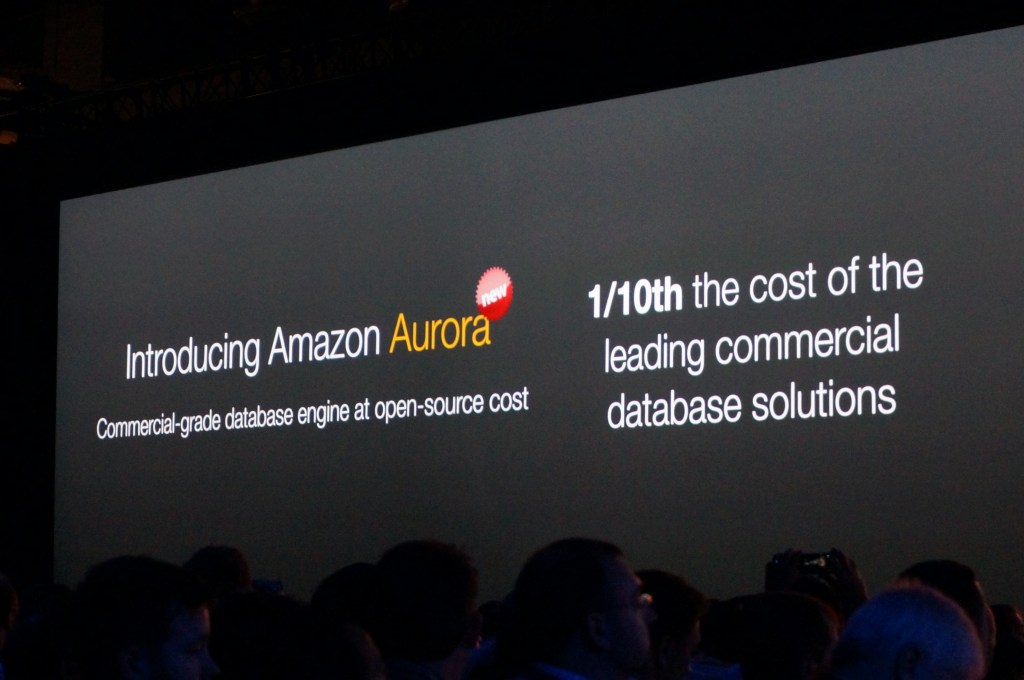
At its re:Invent developer conference in Las Vegas, Amazon today announced Aurora, a new relational database service the company built from the ground up. As Amazon’s Andy Jassy, the head of the company’s cloud services platform, noted in today’s keynote, the company has been working on this project for over three years now.

As enterprises move to the cloud, they also want to move their databases, but in order to avoid having to pay for expensive licenses, they often choose open source tools like MySQL or Postgres. To get those to perform well, though, is hard. So Aurora is a fully MySQL compatible database service that allows you to migrate data into the service easily.
DSC06023
Unlike standard MySQL, the service is extremely fast, however, and set up to be highly available and self-healing. Amazon says the service can handle about 6 million inserts per minute, for example.

A large instance of Aurora starts at $0.29 per hour, without any upfront cost. That’s 1/10th the cost of the leading commercial database solutions, Amazon argues.

The service is now available in preview.
more details:tech crunch

How Google Lost Hundreds of Thousands of Dollars in an Hour and Half


For a brief window this morning, something strange happened to the internet.

At approximately 9:15am ET, display ads disappeared across mega-trafficked media websites such as BuzzFeed, Time, Forbes, Gawker and Vox, replaced instead by big, blank spaces. Some were understandably pleased at the mini-vacation they got from companies making money from their eyeballs, but those running the websites weren’t so happy—and neither was Google. It was the one who was supposed to supply those ads.

The end result? A ton of lost money for all those websites—and for Google. How much? That’s hard to say. But Google alone likely lost several hundred thousands dollars in about an hour and a half—and the other sites lost a comparable amount, if not more.

In the wake of the ads outage, Google scrambled to figure out what caused it, and by 10:45am, most websites were back to normal. Google posted a quick memo—which reads like a sigh of relief—saying things were back up and running.

The glitch was caused by the ad tool called DoubleClick for Publishers, or DFP—a Google advertising service used by many websites to manage ad operations, and whose content is hosted on Google machines rather than the servers that hold the publisher’s own content.

Google says it doesn’t publicly reveal its revenue stream for DoubleClick for Publishers, instead lumping it in under “other” revenue on its earnings reports. That includes anything that doesn’t come from ad revenue on its own websites or from websites that use its AdSense ad network. Based on the company’s 2013 annual report, it made $568,000 per hour in “other” revenue across the internet. Though this includes more than DoubleClick dollars, we can roughly estimate that the company lost something approaching $1 million from this morning’s ad server hiccup.

The last time Google’s DFP system failed was more than a year ago, in March 2013, when the service was down for several hours. This sort of outage may please you in some way, but don’t get used to it. The internet, after all, runs on ads.
more details:wired

Tuesday, 4 November 2014

New Technology And Big Data Help You Breathe Fresh Air


Editor’s note: Ben Heubl is a tech blogger, a data journalist and freelance contributor who writes about technology, entrepreneurship and digital health. Nick Saalfeld is an entrepreneur and corporate journalist specializing in healthcare. He co-founded Yoodoo Media.

Breezometer was conceived because CEO Ran Korber wanted to buy a house. He knew that air pollution caused health problems and he knew that in his native Israel — as with most developed countries — pollution is measured in real time, often at a street-by-street level. Yet, while local school and tax information was available in exhaustive detail for property buyers, there was no simple way to understand the air quality of a neighborhood.

Last March, the WHO announced staggering new numbers indicating that, in 2012, around 7 million people worldwide died as a result of air pollution exposure — twice as high as previous WHO estimates and making it the world’s largest single environmental health risk.

Big data is a big story for 2014-2015. But the value of big data businesses rests in many different components. Sometimes it’s collecting richer data than was previously available, or combining it. Sometimes it’s developing vizualisations that give end users new insight.

Breezometer co-founder and CMO Ziv Lautman says that the company’s initial contribution is doing the heavy lifting of obtaining and deciphering air quality data.

“The data is scattered,” he says. “It comes from many different sources and usually it’s just like a spreadsheet. Different countries have different standards for pollution measurement; in fact sometimes consumers only get told that pollution is “moderate.” That’s not only uninformative, it may mean something different somewhere else.”

The Breezometer team members are, first and foremost, environmental engineers and have used their professional training to make raw air quality data useful.

An app exists for Israel, and a U.S. version is now being launched at the Web Summit 2014; but the company intends to apply its data either in further in-house app developments or by selling the data to third parties.

“We can tell you which park is healthier to play with your kids in, and we could also help your favorite running app decide which route through town will give you the healthiest exercise,” says Lautman. And then of course there is the original real estate proposition. High on Breezometer’s list is a weather app that includes air quality along with the usual weather information.

The rapidly developing mobile health and wearables sector is also a rich opportunity.

“Wearables help us to summarise our day — how much you have slept, or walked,” says Lautman. “Breathing and air quality should be a part of the ‘Quantified Self’ revolution; and just as wearables applications can nudge people to exercise more or watch their diets, we have granular enough data to give users helpful personalized recommendations — right down to closing the windows or putting the air conditioning on.”

Dr. Maria Neira, Director of WHO’s Department for Public Health, Environmental and Social Determinants of Health says that the risks from air pollution are now far greater than previously thought or understood, particularly for heart disease and strokes — which the American Heart Association says are responsible for one in three U.S. deaths. For Lautman, scaling in the U.S. might be a smart move — provided the lived environment can become a priority.

Breezometer is not the only team to spot an opportunity. Other startups are making it their mission to solve air-quality problems. Tel Aviv startup Oxie, expected to launch with a crowdfunding campaign in December, is said to be the first wearable device to effectively purify air without masking your face. Co-founder Sarah Tulin says that it defends the user against all sorts of pollutants: dust, smoke, pollen and even toxic gases, viruses and bacteria.

“Oxie will launch with a neck-worn device, which will be small enough to fit under your collar, letting the user breath purified air without sacrificing style or comfort,” she says.

Similar to Breezometer, Oxie also wants to solve the wider public health problem by applying sensors on the device to track air quality first-hand for the individual user, again delivering a personal air-quality update via an interactive mobile application.

Nine months in, Breezometer is out of “garage mode” and has secured investment from Jumpspeed Ventures and EntrĂ©e Capital. It remains a B2B business for now; the launch app is effectively a demo for the data sales business with an API launching shortly to allow third-party applications, devices and wearables to use the data.

“We’re B2B2C for now”, says Lautman, “but the application of our data to people’s lives may mean we end up connecting directly with customers.”

Why the uncertainty? The sector is much larger than it looks. At a time when health records are being digitized (with greater and lesser degrees of effectiveness in different countries), it’s interesting how little focus there has been on adding validated external data to the citizen health record or personal applications. We already know that big data has lots to offer public health decision-makers, but this could be carried through to individuals; and Lautman says that air quality is just the start.

“Records are kept for all sorts of environmental factors, many of which only get interest from environmental engineers like us,” he says. People experience different degrees of noise, light and additives (anything from harmful pollutants to health-enhancing fluoridation in water), for example. All of these can change our health profiles, and would be a welcome addition to personal health advice services or formal medical records.
“We want to be the environmental health source. People never talk about environmental knowledge as being a part of the healthcare information space, and yet it could be really useful,” says Lautman.

MORE DETAILS:TECH CRUNCH

Google Nexus 6 India Price and Launch Details, Hands On

google_nexus_6_ndtv.jpg
Google is hosting a press event in Taipei for media where, amongst other things, the company showcased the recently announced Nexus 6 and Nexus 9 devices. We got a chance to spend some hands-on time with the smartphone and also got an update on the Nexus 6 price in India and the expected launch date.

NDTV Gadgets has learnt that the Google Nexus 6 will be launched in India within the price range of Rs. 44,000 and Rs. 50,000, with the 32GB model being priced at the lower end of that range and the 64GB becoming available around the top end. The Google Nexus 6, which is being manufactured by Motorola, will be available in India before December 10, with the launch date within this month also a possibility.

The Google Nexus 6 will of course be available via Google Play, and, like other Motorola smartphones, via online retailer Flipkart. Whether it would be Flipkart-exclusive like other Motorola phones is not clear at this point, with the recent completion of Motorola's acquisition by Lenovo potentially having a say on the subject.
As for the device itself, we managed to get some hands-on time with biggest Nexus smartphone yet and our initial impressions are quite positive. Before we'd seen the Nexus 6, we were apprehensive that it would be too large to use comfortably, but during the limited time that we spent with the device, the size didn't prove to be a problem. That being said, we've become used to large screen (5-inch plus) phones and if you are someone who finds a 4-inch display adequate, your mileage may of course vary.

The build quality of the Google Nexus 6 is excellent, and the display looks sharp making Android 5.0 Lollipop with its new colours really stand out. We managed to click quite a few pictures of the Google Nexus 6, and here they are for your viewing pleasure.
google_nexus_6_ndtv_comparison_front.jpgMORE DETAILS:TECH